
Budgeting & Planning
Needs vs Wants Budget: How to Set Categories Without Overcomplicating It
Learn how to organise needs, wants and savings, choose useful budget categories, handle irregular expenses and use a budgeting app without tracking every small purchase.
Needs vs Wants Budget: How to Set Categories Without Overcomplicating It
A needs-and-wants budget can make managing money much easier. The difficult part is deciding what belongs where, how many categories you actually need, and how closely each category should be tracked.
The aim is not to classify every dollar perfectly. It is to create a budget that gives you enough information to make better financial decisions without turning budgeting into another job.
Why divide spending into needs and wants?
Separating needs from wants gives you a quick view of how much of your income is committed to essential living costs and how much remains flexible.
A common starting point is the 50/30/20 budget:
- 50% for needs
- 30% for wants
- 20% for savings or other financial goals
These percentages are guidelines rather than rules. Housing costs, income, family size, location and financial goals can make a very different split more realistic.
What counts as a need?
Needs are generally expenses required for basic living, health, housing or earning an income.
Common needs categories
- Rent or mortgage
- Groceries
- Electricity, gas and water
- Basic phone and internet costs
- Transport needed for work or daily life
- Insurance
- Medical and health expenses
- Minimum debt repayments
- Basic clothing and personal care
A useful test
Ask what would happen if you stopped paying for it. If it would affect your housing, health, ability to work or basic day-to-day functioning, it probably belongs somewhere within your needs.
The same type of expense can be a need or a want
This is where needs-and-wants budgeting becomes less exact.
Clothing is a simple example. Replacing worn-out work shoes may be a need. Buying another pair because you like the style is more likely to be a want.
The same problem appears elsewhere:
| Expense | Possible need | Possible want |
|---|---|---|
| Car | Reliable transport needed for work | Choosing a more expensive model than required |
| Phone | Basic phone and data plan | Premium device or unnecessary plan upgrade |
| Housing | Suitable accommodation | Paying substantially more for optional features |
| Groceries | Normal household food | Some premium or discretionary purchases |
| Clothing | Replacing essential clothes | Fashion purchases that are not required |
You do not need to split every supermarket receipt or clothing purchase into tiny subcategories. The distinction only needs to be useful enough for your household to make consistent decisions.
Do not create more budget categories than you will actually use
It is easy to start with a simple budget and gradually create separate categories for groceries, household supplies, toiletries, clothing, shoes, takeaway coffee, restaurants, subscriptions, entertainment and dozens of other expenses.
More categories provide more information, but they also create more work.
Before creating a category, ask:
- Do I make financial decisions based on this number?
- Do I want to reduce or control spending in this area?
- Is the amount large enough to matter?
- Would separating it make my budget clearer?
If the answer is no, a broader category may be enough.
Broad categories can sometimes work better
Some households prefer detailed budgets. Others monitor only a few major groups.
For example, you might organise variable spending into:
- Needs
- Wants
- Irregular or unplanned expenses
- Savings and financial goals
Within those groups you can still record individual expenses such as groceries, transport or entertainment, but your main budget decision is based on the larger total.
This can be useful if you care more about keeping total discretionary spending under control than whether one category happened to be $40 above its monthly estimate.
Fixed expenses and variable expenses should be treated differently
A mortgage payment and a restaurant bill should not necessarily be managed in the same way.
Fixed or predictable expenses include things such as:
- Mortgage or rent
- Insurance
- Phone plans
- Internet
- Regular subscriptions
- Loan repayments
These expenses are relatively difficult to change from week to week.
Variable expenses such as groceries, eating out, shopping and entertainment are easier to adjust during the month. Tracking these separately can make it clearer where you have room to change your spending.
Should every category have a monthly budget?
Not necessarily.
One method is to give every category an estimated monthly amount. For example:
| Category | Monthly target |
|---|---|
| Groceries | $900 |
| Transport | $350 |
| Eating out | $250 |
| Entertainment | $150 |
Another approach is to set a larger overall target for variable spending. You might allow $1,500 for all flexible spending and worry less about the exact amount used by each category.
Neither system is automatically better. Use the level of detail that helps you control the spending you actually want to control.
Irregular expenses still belong in the budget
One reason budgets appear to fail is that annual and irregular costs are treated as surprises.
Common examples include:
- Car servicing and repairs
- Dental expenses
- Annual insurance
- Home repairs
- School costs
- Replacement appliances
- Occasional clothing purchases
- Gifts
These expenses may not occur every month, but that does not make them unexpected.
A simple solution is a sinking fund. Estimate the future expense and gradually put money aside for it.
If you expect $1,200 of car maintenance over a year, for example, setting aside roughly $100 per month gives the expense somewhere to come from when it arrives.
Savings can come before discretionary spending
Budgeting does not have to mean spending first and saving whatever remains.
Another approach is to decide your savings amount first. Once income arrives:
- Put aside money for savings or longer-term financial goals.
- Cover fixed and essential expenses.
- Use the remaining amount for flexible needs and wants.
This is often called paying yourself first. It can work alongside a needs-and-wants budget or the 50/30/20 approach.
What should a budgeting app actually help you see?
A budgeting app is useful when it reduces the work involved in answering practical questions.
For example:
- How much have I spent this month?
- Which categories are taking most of my income?
- How much of my spending is fixed?
- How much is flexible?
- Am I consistently spending more than I planned?
- How much am I saving?
- Are recurring expenses increasing?
The point is not to produce the most complicated budget possible. It is to make your financial position easier to understand.
Using ZUPITR to track your budget
ZUPITR is designed around broader financial wellness rather than treating budgeting as an isolated spreadsheet exercise.
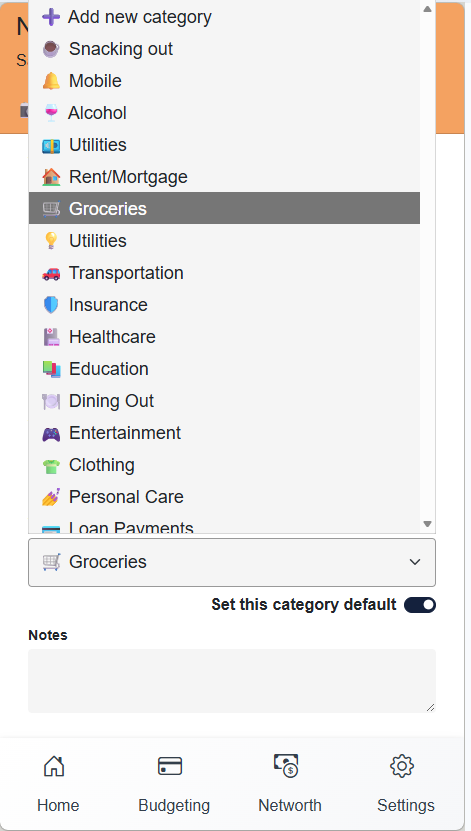
You can record expenses and organise them into categories so you can see where your money is going over time.
Regular expenses can also be recorded as recurring expenses. This is useful for costs such as mortgages, rent, insurance, subscriptions and other payments that repeat on a schedule.
Instead of trying to remember every regular payment each month, you can keep those commitments visible alongside your other spending.
Budgeting is more useful when you can compare it with the rest of your finances
Spending is only one part of financial wellness.
A month with higher expenses is not automatically a bad month. You may have paid an annual insurance bill, repaired your home or made a planned purchase.
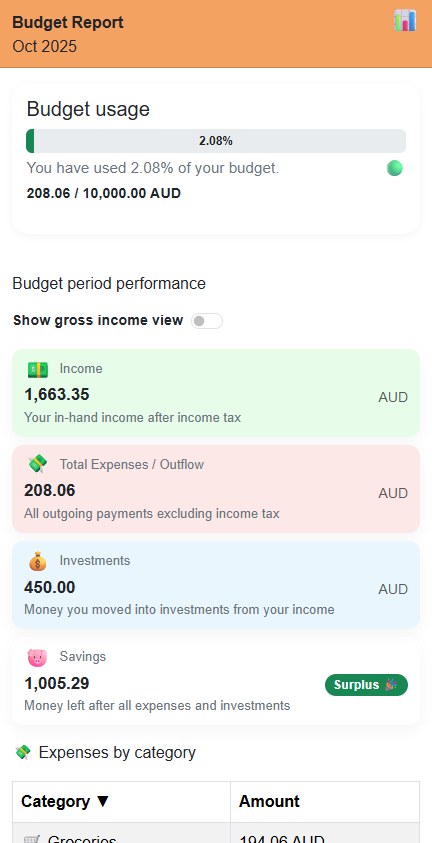
The wider questions are whether your income supports your spending, whether you are saving consistently and whether your overall financial position is improving.
ZUPITR can be used to track expenses alongside income, investments and net worth, giving you more context than an expense total on its own.
A simple budget category structure to start with
If you are starting from scratch, there is no need to create twenty or thirty categories immediately.
Needs
- Housing
- Utilities
- Groceries
- Transport
- Insurance
- Health
- Basic personal expenses
Wants
- Eating out
- Entertainment
- Shopping
- Hobbies
- Optional subscriptions
- Travel
Keep savings and investments separate so that you can see clearly how much of your income is being directed towards future goals.
Add more categories only when the extra detail helps you make a decision.
The budget does not need to be perfect
A useful budget should tolerate normal variation.
If groceries are $80 above your estimate one month, that does not necessarily mean the budget has failed. The important question is what happened to your overall spending and financial goals.
You may spend more on groceries and less on entertainment. You may have an irregular medical expense but still meet your savings target.
Monthly targets are there to help you make decisions. They are not a test you either pass or fail.
When should you create a new category?
A separate category is most useful when you want to understand or change that spending.
Suppose restaurant spending has gradually increased. Creating a dedicated Eating Out category can help you see the amount clearly and set a realistic target.
On the other hand, separating supermarket purchases into food, cleaning products, toiletries and household items may add work without changing any decisions.
Track detail because it is useful, not simply because a budgeting system allows you to.
Choosing a budgeting app
If you are comparing budgeting apps, look beyond the number of categories or charts they provide.
Consider whether the app helps with the way you actually manage money:
- Can you record and categorise expenses easily?
- Can you track recurring expenses?
- Can you see your spending over time?
- Can you keep fixed and variable expenses understandable?
- Can you review income as well as expenses?
- Can you connect budgeting with your savings and net worth?
A budgeting app should make your financial information easier to use. If maintaining the system takes more effort than the decisions it helps you make, the system is probably too complicated.
Keep the system useful
There is no universal list of needs and wants that works for every household.
Decide what the categories mean for your circumstances, keep the structure manageable and review it when your spending or priorities change.
Most importantly, keep sight of the reason for budgeting in the first place: understanding where your money goes and making deliberate choices about what happens to it next.
ZUPITR can help you record expenses, manage recurring costs and view budgeting as part of your wider financial wellness, including income, investments and net worth.