
Net Worth Tracking
Net Worth Tracking: A Practical Way to Measure Your Financial Wellness
If you want to improve your financial position, you first need something you can measure. Net worth is one of the clearest numbers available for doing that.
Net Worth Tracking: A Practical Way to Measure Your Financial Wellness
If you want to improve your financial position, you first need something you can measure. Net worth is one of the clearest numbers available for doing that.
Net worth tracking shows what you own, what you owe and how that position changes over time. The calculation is simple, but deciding what to include, dealing with assets in different currencies and choosing the right view of your net worth can require a little more thought.
What is net worth?
Your net worth is the value of your assets minus your liabilities.
Net Worth = Total Assets − Total Liabilities
Assets may include:
- Cash and bank accounts
- Shares and other investments
- Superannuation or retirement accounts
- Investment properties
- Your home
- Business interests
- Other assets with meaningful financial value
Liabilities may include:
- Home loans
- Investment property loans
- Personal loans
- Car loans
- Credit card balances
- Other money you owe
If your assets are worth $800,000 and your liabilities total $350,000, your net worth is $450,000.
Why track net worth regularly?
Knowing your net worth once is useful. Tracking it over time is much more useful.
A regular net worth record can help you answer questions such as:
- Is my overall financial position improving?
- Are my assets growing faster than my debts?
- Is debt falling?
- How much of my wealth is tied up in property?
- How much can I access relatively easily?
- Are investments making a meaningful difference to my position?
- Has a currency movement changed the value of overseas assets?
Income and spending matter, but they describe what happens to money during a period. Net worth gives you a view of the financial position that has accumulated over time.
The trend matters more than one number
Your net worth can move from month to month. Share prices change, property values move, loan balances fall and exchange rates fluctuate.
This is why a net worth trend is often more informative than looking at today's number in isolation.
A longer history helps you see whether your financial position is generally moving in the direction you want.
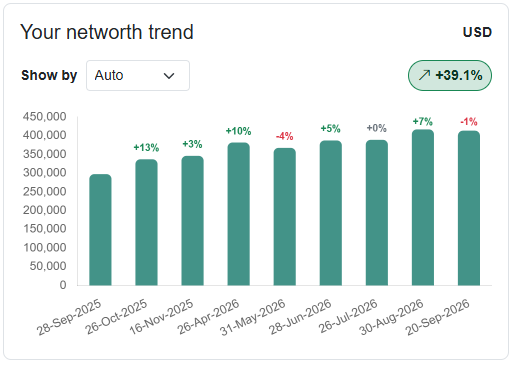
In ZUPITR, you can track your net worth over time and review how the value has changed across different dates.
There is more than one useful way to look at net worth
The standard calculation includes all assets and all liabilities. That is the right starting point, but it does not always answer every financial question.
You may want to look at your financial position in several ways.
1. Total net worth
Include all major assets and subtract all liabilities.
This gives you the broadest view of your financial position. Your home, investments, cash and other major assets can all be included.
2. Liquid net worth
Count assets that can be accessed or converted to cash relatively easily, then subtract your liabilities.
This is a more conservative view. Someone may have a high total net worth but much of it could be tied up in a home or other assets that are difficult to access quickly.
3. Net worth excluding your home
Another view is to exclude your primary residence from your assets while continuing to consider your liabilities.
This can be useful if you want to see how much financial wealth you have outside the home you live in.
Why look at all three?
Each view answers a slightly different question.
| Net worth view | What it helps you understand |
|---|---|
| Total net worth | Your overall assets compared with everything you owe. |
| Liquid net worth | How strong your position looks when focusing on assets that are easier to access. |
| Excluding your primary residence | How much of your financial position exists outside the home you live in. |
These are different views of the same finances. You do not need to choose one and ignore the others.
Understand what your net worth is made of
The total number is important, but its composition also matters.
Two people can both have a net worth of $500,000 while having very different financial positions.
One person may hold most of that value in a primary residence. Another may have a combination of cash, shares, superannuation and investment property.
Looking at your assets and liabilities separately helps you understand where your net worth comes from and how concentrated it is.
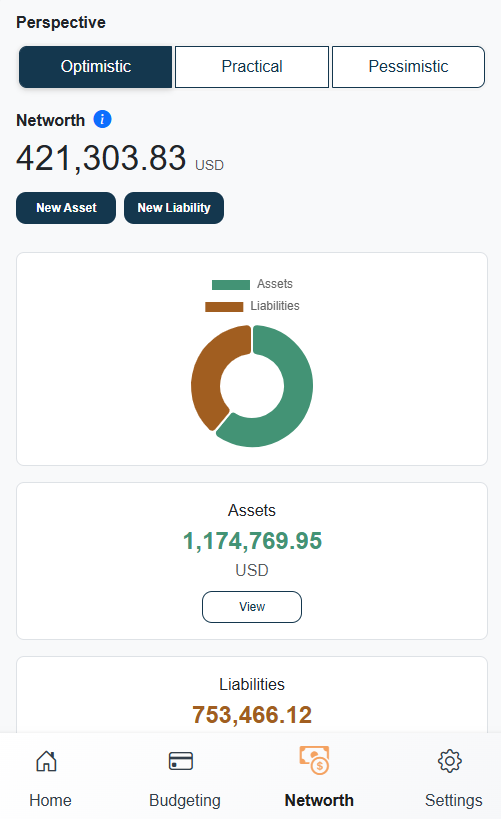
ZUPITR provides a visual breakdown of your assets and liabilities so you can see both the total and the structure behind it.
Net worth tracking becomes harder when you have assets in different currencies
For many people, their finances do not exist in one country or one currency.
This is common for migrants, people who have worked overseas, international investors and families that continue to own property or financial assets in another country.
You might live in Australia but have:
- A bank account in another country
- Overseas shares or managed investments
- A property in your home country
- A mortgage denominated in another currency
- Retirement savings from another country
To calculate your total net worth, those amounts need to be converted into a common currency.
This also means your reported net worth can move even when the underlying asset has not changed in its local currency. A change in the exchange rate can increase or decrease its value when converted into your reporting currency.
A simple multi-currency net worth example
Suppose you live in Australia and track your finances in Australian dollars.
| Asset or liability | Currency | Local value |
|---|---|---|
| Australian bank account | AUD | $40,000 |
| Australian home | AUD | $750,000 |
| Overseas investment | Foreign currency | Local currency value |
| Home loan | AUD | $420,000 |
The overseas investment needs to be converted into Australian dollars before calculating your total net worth.
If the exchange rate changes tomorrow, the Australian dollar value of that investment may also change. This is why multi-currency net worth tracking needs current exchange rates rather than a conversion entered once and forgotten.
Tracking multi-currency net worth with ZUPITR
ZUPITR allows assets and liabilities to be recorded in different currencies.
You can keep an overseas asset in its original currency rather than manually converting it every time you update your finances.
Exchange rates are updated so that ZUPITR can calculate the value of those assets and liabilities in your selected reporting currency.
This also makes currency movements visible as part of your net worth history.
If the value of an overseas investment stays unchanged in its local currency but the exchange rate moves, your reported net worth can still change. That movement is part of your real financial position when everything is measured in one currency.
What should you look for in a net worth tracking app?
If you are comparing net worth tracker apps, start with what you actually need to record.
- Can you record different types of assets?
- Can you track liabilities separately?
- Can you view historical net worth?
- Can you see how your net worth changes over time?
- Can you track assets in multiple currencies?
- Are currency conversions updated?
- Can you see your asset and liability composition?
- Can you calculate more than one view of your net worth?
- Can you review net worth alongside other parts of your finances?
A net worth tracker should make the calculation easier to maintain. The value comes from having an up-to-date record that you can continue using over many years.
How often should you update your net worth?
There is no benefit in updating every asset every day.
For many households, a monthly update is enough to build a useful history without creating unnecessary work.
Some values will naturally move more frequently. Bank balances and investments can change daily. Property estimates may only need occasional adjustment. Loan balances can usually be updated when new statements become available.
Consistency matters more than choosing the perfect frequency. A monthly net worth history maintained for several years is far more useful than a very detailed calculation that you stop updating after three months.
Net worth is useful, but it is not the whole picture
Net worth is a useful measure of financial wellness, but it should not be treated as the only measure.
Cash flow, income stability, emergency savings, debt repayments, insurance, retirement planning and day-to-day spending can all affect your financial position.
Someone with a high net worth can still have cash flow problems. Someone earlier in their career may have a relatively low net worth while building a strong income and saving consistently.
Net worth works best as one important number within a broader view of your finances.
How ZUPITR approaches net worth tracking
ZUPITR brings assets, liabilities and net worth into the same financial record.
You can use it to:
- Record assets and liabilities
- Track your total net worth
- View liquid net worth
- View net worth excluding your primary residence
- Track assets and liabilities in multiple currencies
- Use updated exchange rates for currency conversion
- Review changes in net worth over time
- See the composition of your assets and liabilities
You can then review net worth alongside other areas of your financial life rather than maintaining a separate calculation that is disconnected from everything else.
Start by measuring where you are
You do not need a complicated financial model to start tracking net worth.
List your assets. List your liabilities. Calculate the difference. Save the result and repeat the calculation regularly.
As your finances become more complicated, you can add different views, include overseas assets, account for multiple currencies and review how the composition of your wealth changes.
Whether you use a spreadsheet or a net worth tracking app such as ZUPITR, the useful part is having a consistent measure that shows how your financial position is changing over time.